



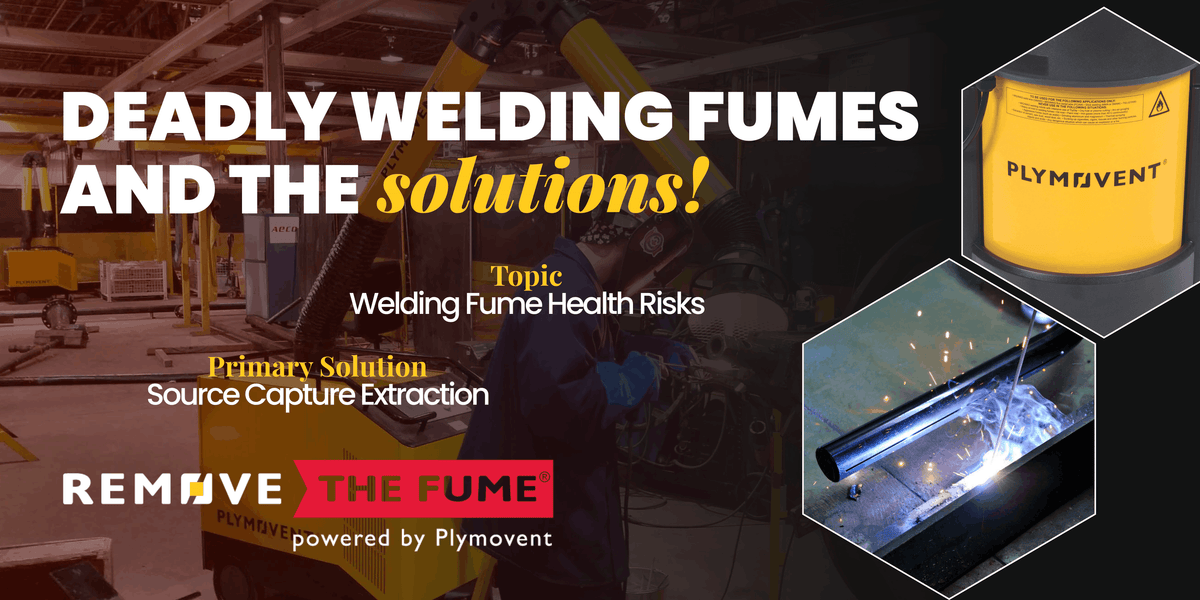
Deadly Welding Fumes and the Solutions
Why Are Welding Fumes So Dangerous?
Welding is essential to manufacturing, construction, transportation, shipbuilding and infrastructure. At the same time, the welding process can expose workers to airborne contaminants that require effective control.
The risk depends on the welding process, material, electrode or wire, coatings, work environment and amount of time a worker is exposed.
What Is Actually in Welding Fume?
During welding, intense heat melts and vaporizes small amounts of metal. As the vapor cools, it condenses into extremely small airborne particles.
Welding fume can contain a mixture of metal oxides, fluorides, silicates and other contaminants. The exact composition depends on the material being welded and the welding process being used.
Fume May Contain
- Iron
- Manganese
- Chromium
- Nickel
- Zinc
- Copper
- Lead
Welding Can Also Generate
- Ozone
- Carbon monoxide
- Nitrogen oxides
These contaminants may enter the breathing zone when they are not properly controlled.
Learn more: Health Risks Associated With Inhalation of Welding Fume Particles
Why Are Fine Welding Fume Particles a Concern?
Much of welding fume is made up of particles that are far smaller than the sparks and debris visible around the welding arc.
Fine particles can remain suspended in the air and may be inhaled deeply into the respiratory system. This is one reason that visible smoke alone is not a reliable way to judge whether the workplace air is adequately controlled.
A welding area can appear clear while airborne contaminants are still present. Effective fume control should be based on the welding process, exposure risk and proper ventilation, not only on whether a visible cloud can be seen.
What Can Welding Fume Exposure Do to the Body?
Health effects vary depending on the contaminant, concentration and duration of exposure. Some effects can occur shortly after exposure, while others are associated with repeated exposure over longer periods.
Welding fumes can irritate the nose, throat and lungs and may contribute to coughing and breathing discomfort.
Exposure to certain metal fumes, particularly zinc oxide fumes, can cause an acute flu-like illness known as metal fume fever.
Excessive occupational exposure to manganese can affect the central nervous system.
Repeated occupational exposure may contribute to longer-term respiratory health problems.
Welding fumes are classified by IARC as carcinogenic to humans.
Risk can change substantially depending on the metals, coatings and welding process involved.
What Is Metal Fume Fever?
Metal fume fever is an acute illness associated with inhalation of certain freshly formed metal oxides. It is commonly associated with zinc oxide exposure, which may occur when welding galvanized steel.
Symptoms can include:
- Fever or chills
- Headache
- Muscle aches
- Nausea
- Fatigue
- Flu-like discomfort
Symptoms should not be treated as a normal part of welding. Exposure conditions should be investigated and appropriate workplace controls used.
Welding Fumes Are Carcinogenic to Humans
The International Agency for Research on Cancer classifies welding fumes as Group 1, meaning there is sufficient evidence that welding fumes can cause cancer in humans.
This makes fume control particularly important for employees who weld frequently and for other workers who spend time in areas where welding fumes can spread.
Learn more in Welding Fume Classified as Carcinogenic to Humans .
How Should Welding Fumes Be Controlled?
Welding fumes cannot simply be eliminated by stopping the welding process. The practical goal is to control the contaminants generated by welding before workers inhale them.
Engineering controls are an important part of that strategy. For many welding applications, this means capturing fumes close to their source using local exhaust ventilation.
Source Capture
Source capture removes welding fumes close to the welding arc before the plume can spread through the workplace.
Dilution Ventilation
Larger welding environments may also use dilution or general ventilation to reduce contaminant concentrations throughout the facility.
Learn more about these approaches in our Guide to Welding Fume Extraction Systems .
Capture the Fume Before It Spreads
Local exhaust ventilation removes contaminants at or close to the source. This reduces the opportunity for welding fumes to enter the welder's breathing zone or disperse throughout the rest of the shop.
Source capture options can include:
Source Capture vs. General Ventilation
| Control Method | What It Does | Typical Use |
|---|---|---|
| Source capture | Removes fumes close to the welding arc | Individual welding stations and focused emission sources |
| Mobile extraction | Provides movable source capture | Changing welding locations and smaller shops |
| Stationary extraction | Provides permanent source capture | Fixed welding stations |
| Dilution ventilation | Reduces contaminant concentrations throughout a larger space | Large facilities or applications where source capture alone is impractical |
How Does a Welding Fume Extractor Work?
A welding fume extractor creates airflow that draws contaminated air away from the welding area. The captured air is directed through the extraction system where airborne particles are filtered or exhausted according to the system design.
A hood, extraction arm or other capture device collects contaminated air close to the welding source.
A fan creates the airflow needed to move welding fume through the system.
Filtration equipment removes captured particulate according to the system and welding application.
For a more detailed explanation, read What Are Welding Fume Extractors and How Do They Work? .
What Type of Fume Extractor Do You Need?
There is no single extraction system that is right for every welding shop. The correct solution depends on how and where welding takes place.
Important considerations include:
- Number of welders
- Hours of welding per shift
- Welding process
- Materials being welded
- Whether workstations are fixed or mobile
- Available floor and wall space
- Overall facility size
Why Fume Extraction Matters Beyond the Welder
Welding fume does not necessarily remain directly above the welding arc. Once released, contaminants can move into the surrounding workspace and potentially affect other employees in the area.
A properly designed fume control strategy can help reduce airborne contamination, support cleaner working conditions and help facilities manage occupational exposure requirements.
Welding Fume Questions
Welding fumes can contain hazardous metal particles and gases. The exact toxicity depends on the materials, welding process, concentration and duration of exposure.
Yes. The International Agency for Research on Cancer classifies welding fumes as Group 1, carcinogenic to humans.
Metal fume fever is an acute flu-like illness associated with inhalation of certain metal oxides. It is commonly associated with zinc oxide fumes generated when welding galvanized metal.
For many applications, local exhaust ventilation that captures welding fumes near their source is an important engineering control. The overall strategy depends on the welding process, facility and exposure conditions.
Not in every application. General ventilation can help manage contaminated room air, but source capture may be needed to remove fumes before they enter the worker's breathing zone.
Welding Fume Is a Controllable Workplace Hazard
Welding may always produce fumes, but worker exposure does not have to be accepted as unavoidable.
Understanding the welding process, identifying the contaminants involved and selecting appropriate ventilation and extraction equipment can help reduce exposure and support a cleaner workplace.
Need Help Controlling Welding Fume?
From mobile fume extractors to larger facility solutions, Remove The Fume can help identify an extraction approach suited to your welding environment.
Contact Us →


