



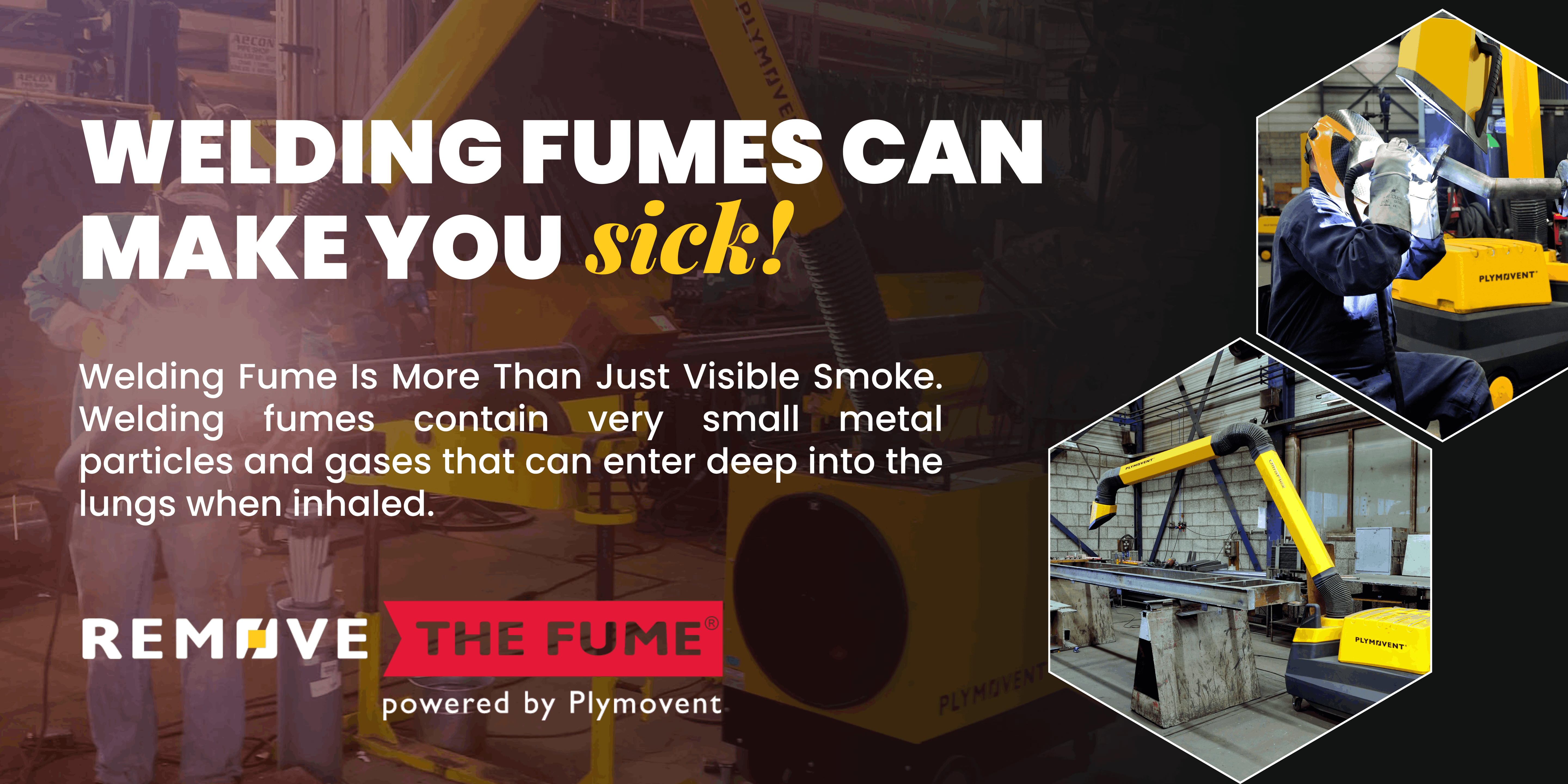
Prevent Welding Fume From Making You Sick
Welding Fume Is More Than Just Visible Smoke
Welding creates extremely high temperatures that can vaporize metal. As the vapor cools, it condenses into very small airborne particles. Together with gases created during welding, these particles form what is commonly known as welding fume.
The exact composition depends on the welding process, base metal, welding wire or electrode, coatings on the material, shielding gases and ventilation conditions.
Welding Fume Can Contain Multiple Hazardous Contaminants
OSHA identifies a range of metals that may be present in welding fumes. The exact combination varies depending on the welding process and materials used.
Common Metals Found in Welding Fume
- Iron
- Manganese
- Chromium
- Nickel
- Copper
- Lead
- Zinc
Gases Can Also Be Generated
- Carbon monoxide
- Nitrogen oxides
- Ozone
Because these contaminants can enter the breathing zone, ventilation and source capture play an important role in exposure control.
How Can Welding Fume Affect Workers?
The effects of welding fumes depend on what is being welded, the concentration of airborne contaminants and how frequently or how long a worker is exposed.
Coughing, throat irritation and shortness of breath can occur following exposure.
Some welding contaminants and gases may contribute to headaches, dizziness or discomfort.
Exposure to certain metal fumes can result in flu-like symptoms known as metal fume fever.
Excessive manganese exposure is associated with neurological health concerns.
Repeated exposure may contribute to longer-term respiratory health problems.
Welding fumes are classified by IARC as carcinogenic to humans.
Welding Fumes Are Classified as Carcinogenic to Humans
In 2017, the International Agency for Research on Cancer classified welding fumes as Group 1, meaning they are carcinogenic to humans.
This classification makes welding fume control an important part of long-term occupational health, particularly in facilities where employees weld regularly throughout the workday.
Read more in Welding Fume Classified as Carcinogenic to Humans .
Authority:
International Agency for Research on Cancer
Why Manganese Deserves Particular Attention
Manganese is commonly present in welding fumes, particularly when welding many types of steel. Excessive occupational exposure is a concern because inhaled manganese can affect the central nervous system.
Neurological Effects
- Tremors
- Muscle stiffness
- Slowed movement
- Coordination problems
Manganism Is Not Parkinson's Disease
High occupational manganese exposure can lead to a neurological condition called manganism. Some symptoms can resemble Parkinson's disease, but the two conditions are not the same.
Source: NIOSH Welding and Manganese
Control the Fume Before Workers Breathe It
The goal of welding fume control is to prevent airborne contaminants from reaching a worker's breathing zone. In many facilities, this involves several layers of protection working together.
Local Exhaust Ventilation
Local exhaust ventilation captures fumes near the welding arc before they spread into the surrounding workspace.
General Mechanical Ventilation
General ventilation helps replace contaminated indoor air with cleaner air and can form part of a broader fume control strategy.
Depending on the application, appropriate respiratory protection may also be required when engineering controls alone cannot adequately control exposure.
Capture Welding Fume Close to the Source
Once welding fumes spread throughout a facility, controlling exposure becomes more difficult. Local exhaust systems are designed to capture the plume close to where it is generated.
Common source capture solutions include:
When Does OSHA Require Mechanical Ventilation?
OSHA identifies certain welding conditions where mechanical ventilation is required. These include specific operations performed in:
| Condition | OSHA Reference |
|---|---|
| Space provides less than 10,000 cubic feet per welder | Mechanical ventilation may be required |
| Ceiling height is less than 16 feet | Mechanical ventilation may be required |
| Welding takes place in confined spaces | Additional ventilation requirements apply |
| Partitions or structural barriers restrict cross ventilation | Mechanical ventilation may be required |
Source: OSHA 29 CFR 1910.252
Hood Position Has a Major Effect on Capture
An extraction system works best when the hood or extraction arm is positioned close enough to capture the rising fume plume before it reaches the worker's breathing zone.
| Hood Distance From Weld | Minimum Airflow Example |
|---|---|
| 4 to 6 inches | 150 CFM |
| 6 to 8 inches | 275 CFM |
| 8 to 10 inches | 425 CFM |
| 10 to 12 inches | 600 CFM |
Choosing the Right Approach
| Method | Primary Purpose | Typical Application |
|---|---|---|
| Local exhaust | Capture fume near its source | Fixed welding stations |
| Mobile extraction | Portable source capture | Changing work locations |
| General ventilation | Remove and dilute contaminated room air | Larger workspaces |
| Respiratory protection | Provide personal respiratory protection | Where additional protection is required |
What Type of Fume Extractor Does Your Shop Need?
Different welding environments require different extraction solutions. A mobile system may work well for a smaller shop or changing work locations, while facilities with multiple permanent welding stations may require stationary or centralized extraction.
Consider factors including:
- Welding process
- Number of welders
- Hours of welding per day
- Materials being welded
- Workstation layout
- Available floor space
- Whether welding locations change
Heavy Fabrication Requires Reliable Fume Control
At Seaspan Victoria Shipyards, two Plymovent Diluter SCS systems were installed in the plate fabrication shop to manage fumes generated during heavy fabrication work.
The installation demonstrates how larger industrial environments may require a different extraction strategy than an individual welding station.
Welding Fume Questions
Yes. Welding fumes can contain metal particles and gases associated with both short-term and long-term health effects. Welding fumes are also classified by IARC as carcinogenic to humans.
Fine welding fume particles can remain airborne for extended periods if they are not removed through appropriate ventilation or extraction.
Not necessarily. A fan may simply move contaminated air around the workplace. Local exhaust ventilation is designed to capture fumes close to where they are produced.
For many applications, capturing welding fumes close to their source using an extraction arm, mobile extractor, hood or other local exhaust system is an effective engineering control.
Welding fume composition varies according to the process and materials being used. Manganese is commonly present when welding many types of steel, but concentrations vary.
Cleaner Air Starts at the Source
Welding fumes should not simply be accepted as part of the job. Proper ventilation, source capture, safe work practices and appropriate protective equipment can help reduce worker exposure.
Capturing fumes close to where they are generated can help keep contaminants away from welders, nearby employees and the wider facility.
Need a Fume Extraction Solution for Your Facility?
From individual welding stations to large fabrication shops, we can help identify an extraction approach suited to your application.
Contact Us →


