



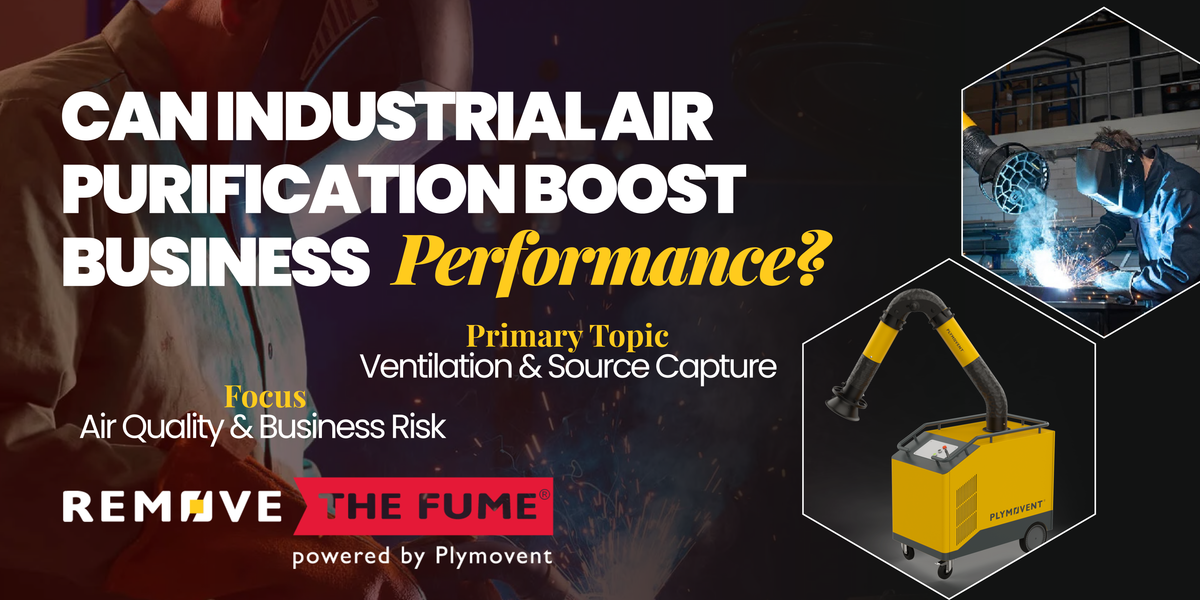
Can Industrial Air Purification Boost Business Performance?
Yes, effective industrial air-quality controls can support the business as well as the worker. Reducing exposure to welding fumes and other airborne contaminants can help lower the risk of occupational illness, reduce associated costs, support regulatory compliance and create a cleaner working environment.
How Can Poor Industrial Air Quality Affect a Business?
Welding, cutting, grinding and other industrial processes can generate airborne particles, fumes and gases that may create health risks when employee exposure is not adequately controlled.
Those health risks can become business risks as well. OSHA notes that workplace injuries and illnesses can create direct costs such as workers' compensation and medical expenses, along with indirect costs including lost productivity, replacement-worker training, investigations and corrective actions.
OSHA currently cites estimates showing that U.S. employers pay more than $1 billion per week in direct workers' compensation costs for disabling, non-fatal workplace injuries.
Source: OSHA Business Case for Safety and Health
What Are the Business Benefits of Better Air Quality Control?
1. Reduce the Risk of Worker Exposure
Welding fumes can contain a complex mixture of metal particles and gases. Welding fumes are classified by the International Agency for Research on Cancer as carcinogenic to humans.
Reducing employee exposure can help address the health risk before it develops into a larger operational or financial problem.
Learn more about welding fume health hazards .
2. Reduce the Cost of Workplace Illness and Injury
Workplace injuries and illnesses can create both direct and indirect costs. OSHA identifies workers' compensation, medical expenses and legal costs as examples of direct costs. Indirect costs can include lost productivity, replacement-worker training, investigations and corrective actions.
3. Support Productivity and Operational Continuity
Employee illness and injury can interrupt production, affect staffing and consume management time. OSHA notes that employers with effective safety and health programs may reduce injury-related costs and can also see improvements in productivity and profitability.
The strongest business case is therefore not simply "cleaner air equals more profit." It is that controlling preventable workplace hazards can reduce avoidable disruption and financial exposure.
4. Support Regulatory Compliance
OSHA does not use a single general "industrial air quality" limit. Instead, employee exposure to specific airborne contaminants is regulated under standards such as 29 CFR 1910.1000 .
For welding and cutting, OSHA requires local exhaust or general ventilation systems to be arranged so that toxic fumes, gases and dust remain below applicable exposure limits.
Certain welding conditions and materials have additional ventilation requirements.
5. Keep Contaminants From Spreading Through the Facility
Welding fume can migrate beyond the immediate welding station when it is not captured. This can expose nearby workers and allow particulate to disperse through the wider shop.
Local exhaust ventilation captures contaminated air closer to where it is generated. NIOSH evaluations have shown that properly used local exhaust ventilation can substantially reduce welding-fume concentrations.
Source: NIOSH Engineering Controls Database
Which Air Purification Method Is Right for Your Facility?
Different controls solve different problems. The correct approach depends on the contaminant, welding process, facility layout and exposure conditions.
| Method | How It Works | Typical Use |
|---|---|---|
| Natural ventilation | Uses natural air movement through doors, windows or openings | May be adequate only where applicable ventilation requirements and exposure conditions allow |
| General mechanical ventilation | Moves and replaces contaminated room air | Overall facility ventilation |
| Local exhaust ventilation | Captures contaminated air close to the source | Fixed or movable welding operations |
| Mobile source capture | Moves a portable extraction unit to the welding location | Changing workstations and smaller facilities |
| Ambient filtration or dilution systems | Controls contaminants that have entered the wider facility air | Larger industrial environments where source capture alone may not address the full application |
Why Is Source Capture Important?
Source capture is designed to remove contaminated air before the fume plume spreads into the wider workplace.
OSHA's welding standard describes movable local exhaust hoods positioned as near as practical to the welding work, with sufficient airflow to control the plume.
NIOSH also identifies local exhaust ventilation as an engineering control for welding fumes. It should be viewed as part of the overall hierarchy of controls, not as a universal replacement for every other control measure.
What Type of Fume Extraction System Should You Use?
The correct system depends on how your facility actually operates. Important questions include:
- How many welders are working?
- How many hours per shift is welding performed?
- Are the welding stations fixed or mobile?
- What metals and coatings are being welded?
- How much fume is generated?
- What filtration is required?
- How large is the facility?
For lower-volume mobile applications, the MobileGo is designed as a light-duty mobile fume extractor for relatively small facilities and changing pollution sources.
For heavier mobile applications, the MobilePro uses a self-cleaning filter cartridge and is designed for more demanding use. :contentReference[oaicite:4]{index=4}
Fixed welding stations may be better suited to stationary extraction systems , while larger production facilities may require a centralized or engineered ventilation solution.
Can Better Air Quality Protect Equipment Too?
Airborne particulate that is not captured can disperse and settle throughout an industrial environment. Keeping contaminants under control can contribute to cleaner work areas and may reduce unnecessary contamination of nearby surfaces and equipment.
However, the amount of maintenance savings varies greatly by process and facility. It is better to describe cleaner equipment and reduced particulate accumulation as a potential operational benefit, rather than promise a specific maintenance-cost reduction.
Can Industrial Air Purification Improve Profitability?
Potentially, yes.
The financial case comes from reducing avoidable risk and disruption. Effective safety and health programs may reduce injuries and illnesses, workers' compensation expenses, medical costs and lost productivity.
OSHA also notes that improvements made for workplace safety can sometimes result in broader productivity and profitability gains.
The important distinction is that fume extraction is not a guaranteed profit generator. It is an engineering control that can help a business manage occupational risk more effectively.
Frequently Asked Questions
Is industrial air purification required by law in the U.S.?
OSHA requires employers to control employee exposure to hazardous airborne contaminants according to the applicable standards and exposure limits. For welding, ventilation requirements are addressed specifically under 29 CFR 1910.252. The exact control required depends on the process, material and workplace conditions.
How much do workplace injuries cost U.S. employers?
OSHA currently cites Liberty Mutual's 2025 Workplace Safety Index, which estimates that employers pay more than $1 billion per week in direct workers' compensation costs for disabling, non-fatal workplace injuries. This figure covers workplace injuries broadly and is not specific to welding or air quality.
Does fume extraction improve productivity?
Fume extraction should not be sold as a guaranteed productivity improvement. Effective workplace safety programs can reduce illness, injury and disruption, and OSHA notes that some employers also experience productivity improvements after implementing stronger safety and health programs.
What is the difference between air filtration and fume extraction?
Fume extraction captures contaminated air close to where the pollutant is generated. Ambient air filtration treats air after contaminants have entered the wider workspace. Depending on the facility, the two approaches may be used together.
Is source capture always required?
No. The required control depends on the welding process, contaminants, facility and applicable exposure requirements. OSHA specifically requires local exhaust in certain applications and conditions, while other environments may use general ventilation or a combination of controls.
Related Reading
- Investing in Industrial Safety: The Long-Term ROI of Fume Extraction
- What Is a Welding Fume Extractor?
- Health Risks Associated With Inhalation of Fume Particles
- Protect Your Employees, Protect Your Business
Need Help Improving Air Quality in Your Facility?
Tell us about your welding process, workstations and facility. We can help narrow down the extraction options that fit your application.
Find the Right System


