



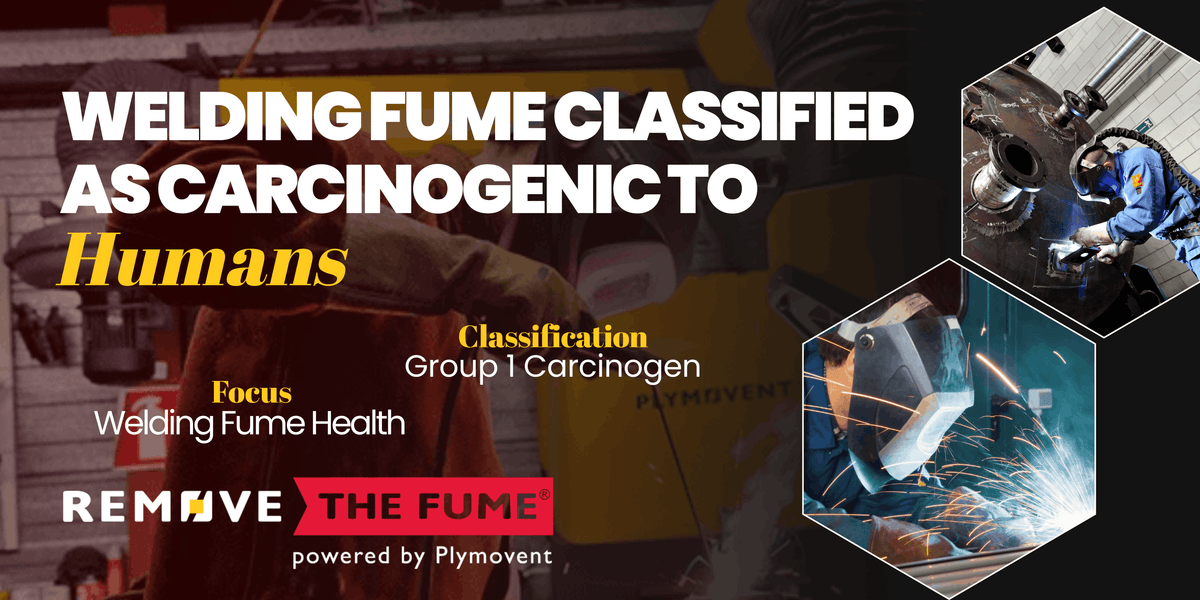
Welding Fume Classified as Carcinogenic to Humans
Welding fumes are classified by the International Agency for Research on Cancer as carcinogenic to humans, Group 1. IARC concluded that there is sufficient evidence that welding fumes cause lung cancer. For welders and employers, reducing unnecessary fume exposure should be part of the workplace control strategy.
Are Welding Fumes Carcinogenic?
Yes. The International Agency for Research on Cancer, the cancer agency of the World Health Organization, classifies welding fumes as Group 1, carcinogenic to humans.
IARC reviewed epidemiological evidence, animal studies and other relevant data as part of its evaluation of welding and welding fumes. The agency concluded that there is sufficient evidence in humans that welding fumes cause lung cancer.
IARC also reported positive associations between welding-fume exposure and kidney cancer.
Source: IARC Monographs Volume 118: Welding, Molybdenum Trioxide, and Indium Tin Oxide
Why Is Welding Fume a Health Concern?
Welding produces a complex mixture of airborne particles and gases. The exact contaminants depend on the welding process, base metal, filler material, electrode or wire, surface coatings and other materials involved.
NIOSH describes welding emissions as a mixture that can include metals, metal oxides and other chemical species generated from the base material, welding electrode or flux.
Welding fumes may contain substances such as iron, manganese, chromium, nickel, zinc and other metals depending on the application.
The health risk depends on what contaminants are present, how concentrated they are in the worker's breathing zone, how frequently welding occurs and how long exposure continues.
Learn more in Welding Fume Facts: What It Is and What It Does to You .
What Did IARC Find About Lung Cancer?
The IARC Working Group reviewed studies involving welders and other workers exposed to welding fumes and concluded that the evidence for lung cancer was sufficient to classify welding fumes as carcinogenic to humans.
Earlier evaluations had classified welding fumes as possibly carcinogenic. The later review considered a larger body of evidence and resulted in the current Group 1 classification.
IARC's evaluation also considered potential factors such as smoking and asbestos exposure. The overall evidence supported an increased lung-cancer risk associated with occupational welding-fume exposure.
What Can Be Present in Welding Fume?
There is no single chemical composition for welding fume. Different welding applications can produce very different mixtures of contaminants.
The materials being welded are especially important. Mild steel, stainless steel, galvanized material and coated metals can all produce different types of fume.
| Material or Process | Potential Concern |
|---|---|
| Mild steel welding | Iron and manganese are commonly present in the fume |
| Stainless steel welding | May generate chromium and nickel-containing fumes |
| Galvanized steel | Zinc-containing fumes can be produced |
| Painted or coated metals | Additional contaminants may be released from coatings |
Safety data sheets for welding consumables and information about the base material should be reviewed when evaluating potential exposure.
Why Does the Breathing Zone Matter?
Welding-fume concentration is generally highest near the point where the fume is generated.
The rising fume plume can pass through the welder's breathing zone before mixing with the surrounding air. Once the fume disperses through the shop, it becomes more difficult to control close to its original source.
How Can Welding Fume Exposure Be Reduced?
Welding-fume control should be based on the actual process, materials, exposure conditions and work environment.
The hierarchy of controls should be considered before relying on personal protective equipment alone.
- Reduce or eliminate unnecessary exposure where practicable.
- Use engineering controls such as local exhaust ventilation where appropriate.
- Keep the worker's head out of the welding plume whenever possible.
- Use safe welding procedures and appropriate training.
- Use respiratory protection when required by the exposure assessment.
NIOSH has evaluated local exhaust ventilation systems used for welding and found that properly applied extraction can substantially reduce airborne welding-fume concentrations. :contentReference[oaicite:1]{index=1}
Sources: NIOSH Welding Operations: Local Exhaust Ventilation Systems and OSHA Welding, Cutting and Brazing Hazards and Solutions
How Does Source Capture Help?
Local exhaust ventilation is designed to collect welding fumes close to the point where they are generated.
A movable extraction arm or mobile fume extractor can be positioned near the welding operation so contaminated air is pulled away before it spreads through the rest of the workspace.
The extraction hood must be positioned correctly. If the work moves, the extraction point may also need to move so it continues to capture the plume effectively.
For facilities reviewing welding-fume controls, the type of extraction system should be selected according to the actual welding workload and work area.
| Extraction Type | Typical Application |
|---|---|
| Portable extractor | Light-duty, maintenance or changing work locations |
| Mobile extractor | Welding that moves between different areas of the shop |
| Stationary extractor | Defined welding stations and repeat production work |
| Downdraft table | Bench welding, grinding and similar applications |
If you are comparing systems, use our Which Fume Extractor Do I Need? guide as a starting point.
Frequently Asked Questions
Are welding fumes carcinogenic?
Yes. IARC classifies welding fumes as Group 1, carcinogenic to humans. The agency concluded that there is sufficient evidence in humans that welding fumes cause lung cancer.
What does Group 1 carcinogenic mean?
Group 1 means there is sufficient evidence that the exposure can cause cancer in humans. It identifies a cancer hazard but does not determine the level of risk for every individual or welding application.
Can welding fumes cause lung cancer?
IARC concluded that welding fumes cause lung cancer based on the available human evidence. Actual occupational risk depends on exposure conditions, contaminants, duration and the effectiveness of controls.
Are welding fumes linked to kidney cancer?
IARC reported positive associations between welding-fume exposure and kidney cancer. Its strongest causal conclusion is for lung cancer.
How can welding-fume exposure be controlled?
Controls may include local exhaust ventilation, suitable general ventilation, worker positioning, safe work practices and respiratory protection when required. The appropriate combination depends on the welding process and exposure assessment.
Does every welding application need the same extraction system?
No. Equipment selection depends on factors such as the number of welding stations, welding process, materials, daily arc time, facility layout and whether the work remains in one location or moves around the shop.
Related Reading
Need Help Controlling Welding Fume?
Tell us about your welding process and work area. We can help narrow down the extraction options that fit your application.
Find the Right System


