



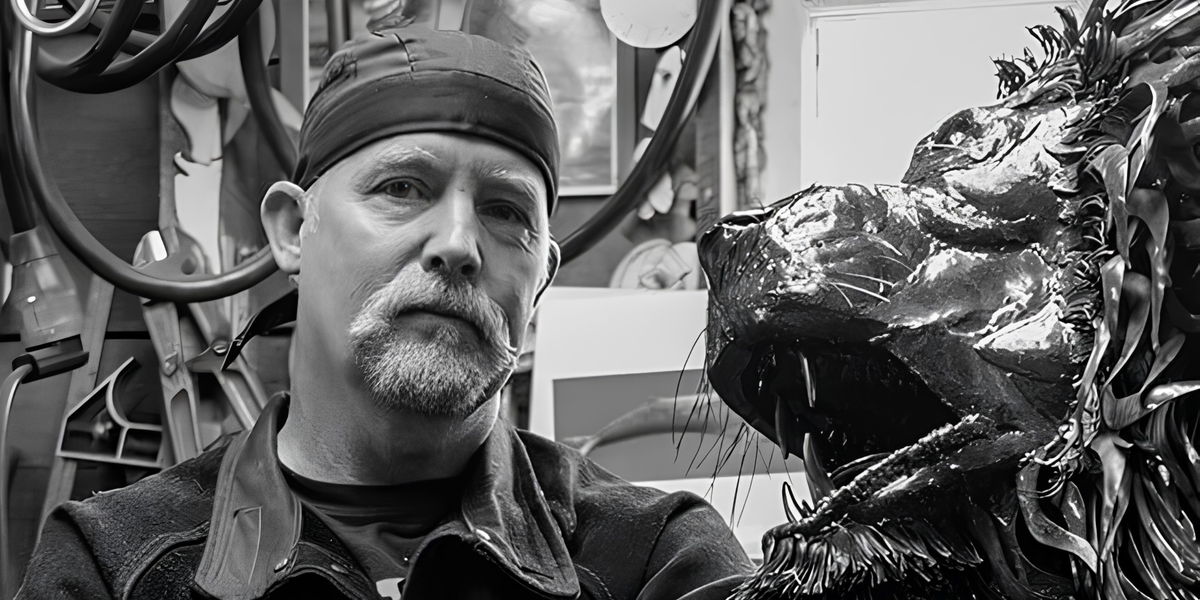
Story of a Professional Welder
Professional welder and metal artist Rich Baker of RichCraft Ironworks works across automotive restoration and wildlife sculpture from two separate shops. In this interview, Rich shares how his welding career evolved, what inspires his metal artwork, and how he uses Remove The Fume extraction equipment for different welding and grinding applications.
Meet Rich Baker of RichCraft Ironworks
Rich Baker has spent years working professionally as a welder. His career has ranged from welding in the industrial sector to operating two welding studios and creating detailed wildlife sculptures from metal.
Rich has also built a following within welding and metalworking communities for the wildlife creations produced through RichCraft Ironworks.
Remove The Fume sat down with Rich to talk about his career path, his creative process, and how welding fume extraction fits into the way he works.
Rich, how did your career as a professional welder lead to creating wildlife sculptures?
I’d like to say that where I am now as a career was a planned destination, however this would be untrue. Sometimes the best things in life are unplanned. I was running a welding department for a large industrial company about ten years ago when I decided I wanted to venture out on my own.
My initial plan was to open a weld shop on my property and offer my services to the local farming community. While waiting for clients to start showing up, I started experimenting with sculpting small figurines out of antique nails and as luck would have it, I landed a small wholesale contract making these figurines.

Early inspiration from the RichCraft Ironworks portfolio.
This took off quickly and lasted for over a year. From these small nail figurines it evolved slowly into animals sculptures. I simply gravitated to what really interested me and with my love for nature I was really just creating what I observed.
As it turns out, the only farm equipment welding I ever did was to weld a pig trough for a local hobby farm.
How Does Rich Use Welding Fume Extraction in His Shops?
Rich operates two separate shops on his property, and each space presents a different extraction challenge. One is used primarily for automotive restoration. The other is dedicated to his sculptural work. :contentReference[oaicite:1]{index=1}
You operate two welding shops. What type of work do you perform in the larger shop?
Presently I’m running two separate shops on my property (you can never have enough shop space). In the larger original shop I weld for my second passion in life, automotive restoration.
It’s mostly restoration work on vintage Land Rover vehicles which I do in partnership with my two brothers. It’s a booming little company called 3 Brothers Classic Rovers.

Rich Baker with 3 Brothers Classic Rovers.
Which Remove The Fume units do you use for automotive restoration work?
In this shop I utilize the MFD mobile fume extractor and the very handy PHV Portable Fume Extractor .
The MFD is my primary fume extractor, used for welding applications on vehicles or when I’m using a rotisserie for firewall repairs.
When I’m heading into tight spots, say under a vehicle, I use my PHV portable unit. With the magnetic hose connection of this portable unit, it’s ideal for having fume extraction right up close to the source.
What extraction challenge did you have in your smaller sculpture shop?
In my smaller shop I do my sculptural work. This shop presented a challenge due to the lack of floor space.
With RTF’s help, the solution to this problem was the incredible SFS self-cleaning stationary fume extractor .
This unit mounts on the wall as to not take up too much floor space. It’s also an amazing unit because of its ability to remove grinding dust.
In a small shop, besides fumes, grinding dust is my biggest problem. I used to have to leave the shop to literally let the air clear so I could work and breathe. This welding fume extractor solves both these issues for me.
What Inspires Rich Baker's Metal Wildlife Art?
Did living in Northern Ontario influence your wildlife sculptures?
I actually only resided in the North for a few years. Since I was a young boy (not admitting that I’m old now), I have been traveling and exploring everything the great north country has to offer.
Camping, road trips, and outback canoe adventures are a treasured part of my life. However it wasn’t until several years after we moved back to Southwestern Ontario that the sculptural art portion of my life came into play.
Looking back though, living in that environment absolutely created a positive lasting effect on me and continues to inspire what I do today. I still try to get up North as much as possible each year.
Birds of prey appear often in your work. Do you have a favorite?
Yes, Birds of Prey have always held a fascination for me. And yes, while I have created a Peregrine Falcon, my favorite Bird of Prey would have to be the Red Tail Hawk.
The skies over my shop are filled with these magnificent hunters. My very first bird was a Red Tail Hawk.

A Red Tail Hawk created by Rich Baker in his Southern Ontario studio.
When did you first begin creating the type of hollow-body sculptures you make today?
My first attempt at what I consider a hollow body sculpture such as I make now was quite rudimentary but it still makes me smile when I look back. This was a short 9 years ago.

An earlier RichCraft Ironworks metal art creation.
Where does the inspiration for your wildlife sculptures come from?
My inspiration comes from a lifetime of adventures in the outdoors. I continually draw from memories of my encounters with wildlife in their backyard.
Most of these encounters occurred with my interior canoe trips and camping excursions in Algonquin, KillBear and Killarney Provincial Parks just to name a few.
Today I am also inspired by the challenge of creating lifelike representations of the animals I see. Muscle texture, feather placement and proportion are all so important but creating a piece that looks realistic from a material that doesn’t naturally mimic nature is a challenge I take on gladly with every piece.
Did Fume Extraction Change the Air in Rich's Shop?
After learning more about welding-fume hazards, have you noticed a difference since using fume extraction?
Absolutely! Not only have I noticed a difference in the air quality of my shop, but even visibly the difference is outstanding.
My shop used to have an unpleasant over hanging “blue haze” after a day of welding. I haven’t dealt with those unhealthy conditions since my introduction and partnership with RTF.
Welding fumes are now classified by IARC as carcinogenic to humans. For more information on the classification and welding-fume health risks, read Welding Fume Classified as Carcinogenic to Humans .
Are you more conscious of the metals you use and the hazards associated with welding?
Simply from the fact that I’m aware of the hazards that go with the welding process makes me contentiousness of my safety.
I try to steer away from these metals and I’m fortunate that in most cases, I can chose which alloys I use in my creations. However, there are times when my work does require using these materials.
My mind is at ease knowing I have the best in fume extraction at my fingertips.
Why Does Professional Equipment Matter to Rich?
My partnership with RTF goes hand in hand with all of my sponsors. I’m very fortunate to be working with incredible companies such as yourselves, Fronius (weld units), Fein industrial tools and 3M Speedglas weld helmets.
Each company and their support plays an intricate part in my process of creating. I’m a firm believer that in order to be the best that you can be at what you do, you need the best equipment to bring that vision to fruition.
I equate this belief to my earlier years in the music business. If you’re on stage with a cheap guitar and mic, chances are your performance will be less than stellar…no matter how talented you are. Great equipment helps me be the best I can be.
Where Can You Find Rich Baker's Work?
How do customers find and purchase your metal artwork?
In addition to selling my pieces through the Algonquin Art Centre, I do also offer my works as they come available though our website RichCraft Ironworks .
I also work privately with clients on commissioned pieces to bring their vision to life.
Frequently Asked Questions
What fume extractors does Rich Baker use?
In the original interview, Rich said he used three Plymovent systems through Remove The Fume: the MFD mobile fume extractor, the PHV portable fume extractor and the SFS stationary self-cleaning fume extractor. Each system was used for a different type of work or shop environment.
Why does Rich use a portable fume extractor?
Rich uses the PHV for tight or difficult-to-reach areas, including work underneath vehicles. He specifically highlighted its magnetic hose connection because it allows the extraction point to be positioned close to the welding source.
Which extractor does Rich use for automotive restoration?
Rich described the MFD as his primary fume extractor for automotive restoration, including welding on vehicles and firewall repairs performed with a rotisserie.
What extractor does Rich use in his smaller sculpture shop?
Rich uses the wall-mounted SFS in his smaller sculpture shop. He selected it partly because floor space was limited and said the system also helped him manage grinding dust in the shop.
Did Rich notice a difference after using welding fume extraction?
Yes. Rich said he noticed both an air-quality and visible difference. Before using RTF equipment, he described an unpleasant blue haze that could remain in his shop after a day of welding. :contentReference[oaicite:3]{index=3}
What inspires Rich Baker's wildlife sculptures?
Rich says much of his inspiration comes from a lifetime spent outdoors, including camping, canoeing and encounters with wildlife in places such as Algonquin, Killbear and Killarney Provincial Parks. :contentReference[oaicite:4]{index=4}
Related Reading
Need Fume Extraction for Your Shop?
Different welding environments require different extraction setups. Compare mobile, portable and stationary options based on how and where you weld.
Find the Right System


