



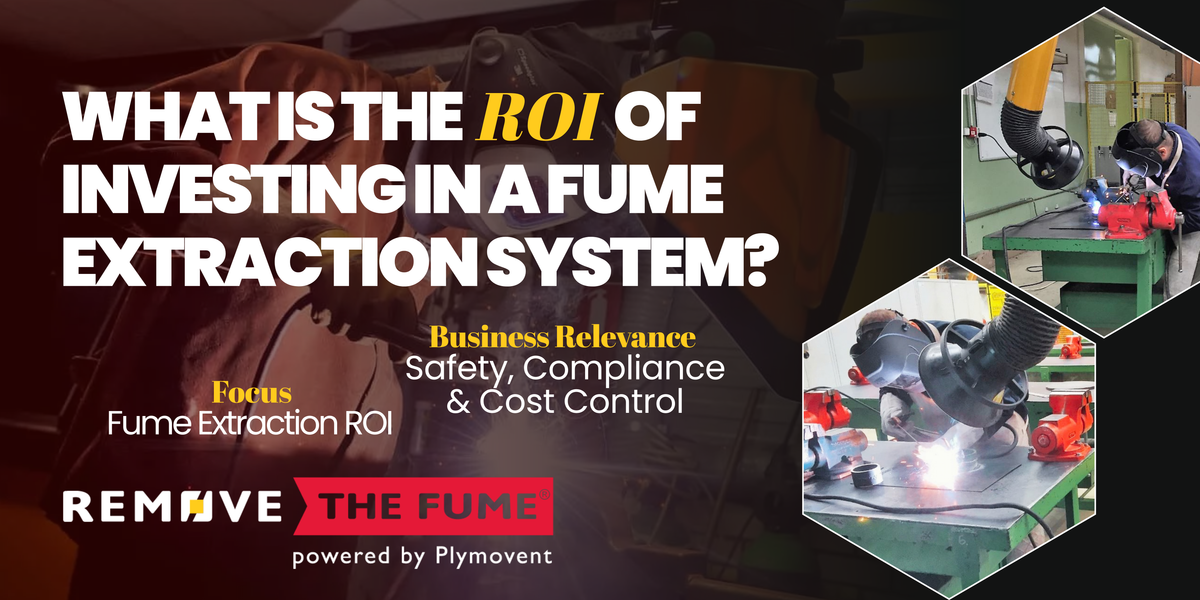
What Is the ROI of Investing in a Fume Extraction System?
The return on a fume extraction system comes from more than one place. A properly selected system can help reduce welding-fume exposure, support regulatory compliance, limit downtime and other indirect safety costs, and create a cleaner working environment. The actual ROI depends on the facility, workforce, welding volume and system selected.
How Can Fume Extraction Produce a Return on Investment?
The ROI of a fume extraction system is not simply the purchase price compared with one avoided expense.
The business case can include reduced exposure to welding fumes, lower risk of injury and illness-related costs, less disruption from safety incidents, improved compliance, and better control of contaminants in the work environment.
OSHA notes that workplace injuries and illnesses create both direct and indirect costs for employers. Direct costs can include workers' compensation, medical expenses and legal services. Indirect costs can include lost productivity, replacement-worker training, accident investigation, absenteeism and lower employee morale.
Source: OSHA Business Case for Safety and Health
1. Reducing Welding Fume Exposure
Welding fumes are a recognized occupational health hazard. The International Agency for Research on Cancer classifies welding fumes as Group 1, carcinogenic to humans, and concluded that welding fumes cause lung cancer.
Welding fumes can also contain metals and compounds that vary according to the welding process, electrode, base material and surface coatings.
Reducing worker exposure is therefore one of the primary reasons facilities invest in fume-control equipment.
Learn more in Welding Fume Classified as Carcinogenic to Humans .
2. Reducing the Cost of Workplace Injuries and Illnesses
Workplace health and safety problems can create costs far beyond a medical bill.
OSHA identifies several direct and indirect costs associated with workplace injuries and illnesses, including:
- Workers' compensation payments
- Medical expenses
- Legal costs
- Lost productivity
- Training replacement employees
- Accident investigation
- Corrective measures
- Absenteeism
- Lower employee morale
A fume extraction system does not eliminate every welding-related risk. It addresses one important category of exposure by helping control airborne contaminants generated during welding.
3. Supporting Regulatory Compliance
Employers are responsible for controlling occupational exposures according to the regulations that apply in their jurisdiction.
In the United States, OSHA's welding requirements address ventilation and require local exhaust or general ventilation systems where necessary to keep toxic fumes, gases and dusts below applicable exposure limits.
In Canada, occupational health and safety requirements vary by province, territory and federal jurisdiction. CCOHS guidance recommends evaluating worker exposure and identifies local exhaust ventilation as the most effective welding ventilation strategy.
Investing in properly designed extraction can therefore form part of a facility's overall strategy for meeting exposure-control requirements.
Sources: OSHA 29 CFR 1910.252 and CCOHS Welding Ventilation
4. Controlling Downtime and Operational Disruption
Safety problems can interrupt production in several ways. Employees may miss work, supervisors may need to investigate incidents, replacement staff may require training, and corrective actions can consume time and resources.
OSHA includes lost productivity, replacement-worker training and corrective measures among the indirect costs employers may experience following workplace injuries and illnesses.
Engineering controls such as fume extraction are intended to reduce exposure before the contaminant reaches the worker rather than managing the consequences afterward.
5. Creating a Better Welding Environment
Welding fumes can spread beyond the immediate welding station if they are not captured close to the source.
Local exhaust ventilation removes contaminated air near the point where it is generated. This can help reduce the amount of welding fume that reaches the worker's breathing zone or disperses through the facility.
For employers competing for experienced welders and skilled tradespeople, providing effective exposure controls can also demonstrate that workplace health and safety is being taken seriously.
6. Matching the Investment to the Actual Workload
ROI depends heavily on choosing the right system.
Buying more equipment than the application requires creates unnecessary capital cost. Buying too little can result in poor capture performance or equipment that is not suited to the welding workload.
Important factors include:
- Number of welding stations
- Hours of active welding per day
- Welding process
- Materials being welded
- Amount of fume generated
- Whether the work stays in one location
- Required mobility
- Filter capacity and replacement requirements
- Available floor and wall space
For smaller or changing work areas, a mobile extractor may make more financial sense than installing a larger fixed system. Facilities with several permanent welding stations may benefit from a different approach.
Compare two common options in MobileGo vs. MobilePro: Which Fume Extractor Is Right for Your Shop? .
Fume Extraction vs. No Extraction: Where Can the Costs Appear?
| Cost Area | Without Adequate Control | With Appropriate Extraction |
|---|---|---|
| Worker exposure | Greater potential for fume to reach the breathing zone | Contaminants can be captured close to the source |
| Compliance | Greater risk that exposures are not adequately controlled | Engineering control can support an exposure-control program |
| Downtime | Potential disruption from health and safety issues | Reduced exposure can lower one source of operational risk |
| Air quality | Fume can disperse into the surrounding workplace | Local exhaust removes contaminants before they spread |
| Capital cost | No extraction-system investment | Upfront equipment, installation and ongoing maintenance costs |
How Do You Calculate the ROI of a Fume Extraction System?
There is no universal payback period because every facility has different costs, exposure conditions and production requirements.
A useful ROI estimate starts by comparing the total cost of owning the system with the measurable costs the investment is expected to reduce.
When building the calculation, consider:
- Equipment purchase price
- Installation cost
- Filters and routine maintenance
- Energy use
- Current health and safety incident costs
- Absenteeism and lost production
- Corrective-action costs
- Exposure-monitoring costs
- Potential compliance-related costs
- Expected service life of the equipment
Facilities should use their own historical costs rather than assuming that every fume extraction system will pay for itself within a fixed number of months.
What Is the Payback Period?
Payback period measures how long it takes for the estimated savings or avoided costs to equal the initial investment.
For example, a system with a total installed cost of $20,000 and an estimated measurable benefit of $5,000 per year would have a simple payback period of approximately four years.
That is only an illustration. Actual results depend on the facility and should be calculated using real operating data.
Does Fume Extraction Save Energy?
The answer depends on the system design.
CCOHS notes that local exhaust ventilation can require less makeup air than dilution ventilation because it removes smaller volumes of contaminated air close to the source. In facilities where conditioned replacement air must be heated or cooled, that difference can affect operating cost.
Energy savings should therefore be evaluated as part of the complete system design rather than assumed for every installation.
Frequently Asked Questions
How much does a fume extraction system cost?
Cost depends on the type of system, airflow requirements, filter configuration, duty cycle, number of welding stations and whether installation or ducting is required. Portable and mobile systems generally involve a different investment than larger stationary or centralized systems.
Does a fume extractor pay for itself in one year?
Not necessarily. There is no universal one-year payback period. ROI should be calculated using the facility's actual equipment cost, maintenance expenses, operating costs and measurable safety or productivity-related savings.
Is welding fume extraction legally required in Canada?
Requirements vary by province, territory and federally regulated workplace. Employers must control hazardous exposures according to the rules that apply to their jurisdiction. CCOHS identifies local exhaust ventilation as the preferred method for removing welding fumes and gases.
What health risks are associated with welding fumes?
The risks depend on the welding process, materials and level of exposure. Welding fumes are classified by IARC as carcinogenic to humans, and CCOHS identifies potential effects including respiratory irritation, metal fume fever, nervous-system effects and other health concerns depending on the contaminants present.
How long does a fume extraction system last?
There is no single service-life figure for every system. Equipment life depends on duty cycle, maintenance, filter loading, operating conditions and whether the system is used within its intended capacity. Regular inspection and maintenance are important for maintaining extraction performance.
What type of fume extractor provides the best ROI?
The best ROI usually comes from selecting equipment that matches the actual application. A mobile unit can make sense when welding moves around the facility, while fixed workstations or multiple welders may justify stationary or larger extraction systems.
Related Reading
Need Help Choosing the Right Fume Extraction System?
Tell us about your welding process, number of stations and daily workload. We can help narrow down the extraction options that fit your application.
Find the Right System


