



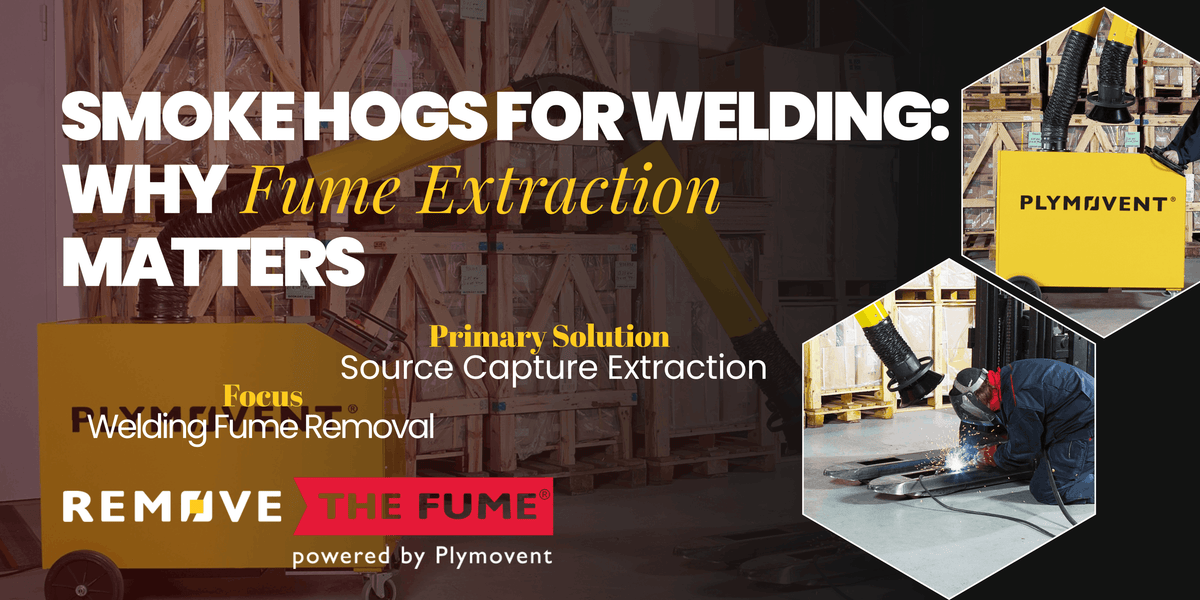
Smoke Hogs for Welding: Why Fume Extraction Matters
“Smoke hog” and “smog hog” are common terms some welders and fabricators use for welding fume extraction equipment. Whatever name is used, the purpose is the same: capture hazardous welding fumes and fine particles as close to the source as practical before they enter the breathing zone or spread throughout the workplace.
What Is a Smoke Hog for Welding?
In welding shops, terms such as “smoke hog” or “smog hog” are sometimes used informally to describe equipment that removes welding fumes, smoke and fine airborne particles.
The more precise term is a welding fume extractor or local exhaust ventilation system.
Welding fume extractors are designed to capture contaminated air near the point where welding, cutting or grinding takes place and move it through an appropriate filtration system.
Are Open Doors and Fans Enough for Welding Fume?
Opening workplace doors and windows can increase natural ventilation, but this should not automatically be considered sufficient protection from welding fumes.
CCOHS describes natural dilution ventilation, including open doors and windows, as the least effective of the main welding-ventilation strategies because there is little control over how contaminants move through the workplace.
CCOHS identifies local exhaust ventilation as the preferred method for removing welding fumes and gases because contaminants are captured before they mix with the surrounding room air.
Simply blowing air with a fan can also move welding fumes from one part of a shop to another rather than controlling them at their source.
Source: CCOHS Welding Ventilation
Why Is Welding Fume a Health Concern?
Welding fumes are made up of very small airborne particles and gases generated by welding and related processes. Their composition depends on the welding process, base metal, filler metal, coatings and other materials involved.
In 2017, the International Agency for Research on Cancer classified welding fumes as Group 1, carcinogenic to humans.
IARC concluded that welding fumes cause lung cancer. Positive associations with kidney cancer have also been observed.
Learn more in Welding Fume Classified as Carcinogenic to Humans .
Why Should Welding Fume Be Captured at the Source?
Welding fumes are easiest to control before they spread through the surrounding workspace.
OSHA recognizes movable local exhaust hoods that are positioned as close as practical to the welding work. The extraction system must provide sufficient airflow to draw fumes toward the hood and away from the worker.
Effective source capture can help:
- Reduce the amount of welding fume reaching the breathing zone
- Limit the spread of airborne particles through the facility
- Reduce settling of welding and grinding dust on surrounding surfaces
- Support the facility's overall exposure-control strategy
- Protect other workers who share the same indoor air space
Who Is Responsible for Controlling Welding Fume?
Employers and workplace managers are responsible for identifying occupational hazards and implementing controls that meet the regulations applicable to their workplace.
The exact requirements depend on the jurisdiction, process, materials and measured worker exposure.
In the United States, OSHA requires local exhaust or general ventilation systems to be arranged so toxic fumes, gases and dusts remain below applicable exposure limits.
This does not mean that one particular type or brand of extractor is legally required for every welding operation. The correct control method should be based on the actual hazard and exposure assessment.
What About Welding Outdoors?
Welding outdoors does not automatically eliminate welding-fume exposure.
Wind direction, worker position, welding process, material and the toxicity of the contaminants all affect exposure. The welder should remain out of the plume, and additional controls may still be required depending on the work being performed.
Certain materials require additional precautions even when welding or cutting takes place outdoors.
How Do Metal Coatings Affect Welding Fume?
Base metals, plating, paints, coatings and filler materials can all change the composition and toxicity of welding fumes.
Welding or cutting coated materials may introduce substances such as zinc, lead or cadmium into the fume.
Metal fume fever is commonly associated with exposure to certain metal-oxide fumes, particularly zinc oxide generated when working with galvanized metal.
Cadmium is especially hazardous. OSHA requires specific ventilation or respiratory controls for welding and cutting involving cadmium-bearing materials.
Why Should Safety Data Sheets and Equipment Manuals Be Available?
Safety information should be accessible to employees and supervisors working with welding materials and extraction equipment.
CCOHS recommends following manufacturer instructions, safety data sheets and appropriate hazard-control measures when working with welding fumes and gases.
Useful documentation can include:
- Safety data sheets for welding consumables
- Safety data sheets for coatings and materials
- Fume extractor operating manuals
- Filter specifications
- Maintenance instructions
- Inspection and service records
- Workplace exposure assessments where applicable
Keeping these documents readily available can also make it easier for employees, supervisors and safety personnel to confirm that equipment is being operated and maintained correctly.
Which Type of Welding Fume Extractor Do You Need?
Remove The Fume, powered by Plymovent, offers portable, mobile and stationary welding fume extractors for different workloads and shop layouts.
The right system depends on factors such as welding volume, number of workstations, available floor space, mobility requirements, materials being welded and required filtration.
| Product | Type | Best Fit |
|---|---|---|
 MobilePro
|
Heavy-duty mobile | Higher welding volumes, stainless steel, grinding and demanding mobile applications |
 DualGo
|
Light-duty stationary, dual arm | Two fixed welding workstations where floor space is limited |
 MonoGo
|
Light-duty stationary | One fixed welding station and occasional to regular light-duty welding |
 MobileGo
|
Light-duty mobile | Smaller facilities and welding locations that change |
 SFD
SFD
|
Medium-duty stationary | Fixed welding stations using disposable filtration |
 SFS
SFS
|
Medium/heavy-duty stationary | Fixed workstations requiring higher-duty use and self-cleaning filtration |
 PHV
PHV
|
Portable high vacuum | Tight spaces, maintenance work and hard-to-reach welding locations |
 MFD
MFD
|
Medium-duty mobile, disposable filter | General fabrication and welding across multiple work locations |
 MFS
MFS
|
Medium-duty mobile, self-cleaning | Mobile welding applications where automatic filter cleaning is preferred |
Product configurations, filtration options and pricing can change. Review the current product page before selecting equipment for a specific application.
Portable, Mobile or Stationary: Which Is Better?
There is no single fume extractor that is right for every fabrication shop.
| Extractor Type | Typical Application | Main Advantage |
|---|---|---|
| Portable | Maintenance, confined or hard-to-reach areas | Compact and easy to move close to the work |
| Mobile | Welding that moves between different locations | Source capture can follow the welder |
| Stationary | Permanent welding stations | Keeps extraction equipment off the shop floor |
| Dual-arm stationary | Two nearby welding stations | One system can serve two extraction arms |
Why Does Extraction-Arm Position Matter?
A fume extractor can only capture welding fumes effectively when the extraction point is positioned correctly.
CCOHS recommends positioning a movable hood as close as practical to the work. OSHA likewise describes movable local exhaust hoods as being placed near the welding operation.
If the welder moves along a large workpiece, the extraction arm should also be repositioned so it remains close enough to capture the plume.
Does Fume Extraction Protect Everyone in the Shop?
Welding fume can spread beyond the person performing the weld.
Helpers, nearby employees and other people working in the same air space may also be exposed when fumes are allowed to disperse throughout a facility.
Source capture is therefore not only about the individual welder. It is part of maintaining a cleaner working environment for everyone sharing the shop.
Frequently Asked Questions
What is a smoke hog for welding?
“Smoke hog” is an informal term sometimes used for equipment that removes welding fumes, smoke and airborne particles. The more technical term is a welding fume extractor or local exhaust ventilation system.
Is opening the shop door enough ventilation for welding?
Not necessarily. CCOHS describes natural ventilation through open doors and windows as the least effective welding-ventilation method. Local exhaust ventilation is preferred because it captures contaminants closer to their source.
Can I just use a fan to blow welding smoke away?
A general fan may move welding fumes but does not necessarily capture or remove them from the workplace. Depending on its position, it can simply move contaminants toward other employees. Ventilation should be designed around the actual welding hazard and exposure conditions.
Are welding fumes carcinogenic?
Yes. IARC classifies welding fumes as Group 1, carcinogenic to humans, and concluded that welding fumes cause lung cancer.
Can welding fumes affect workers who are not welding?
Yes. Welding fumes can disperse beyond the immediate welding station when they are not adequately captured, potentially exposing other people who share the work area.
What is the best type of welding fume extractor?
The best system depends on the welding process, amount of welding performed, materials, number of stations, shop layout, mobility requirements and filtration needs. Portable, mobile and stationary systems are designed for different applications.
Should I keep the fume extractor manual at the job site?
Equipment manuals, safety data sheets, filter information and maintenance instructions should remain readily accessible so employees can operate and maintain the equipment correctly.
Do welding fumes contain dust?
Welding fume consists primarily of very small airborne particles formed when vaporized material cools and condenses. Grinding and other fabrication processes can also generate particulate dust that may require extraction and collection.
Related Reading
Which Fume Extractor Does Your Shop Need?
Tell us what you weld, how often you weld, how many workstations you have and whether the work moves around the shop. We can help narrow down the extraction system that fits your application.
Find the Right System


