



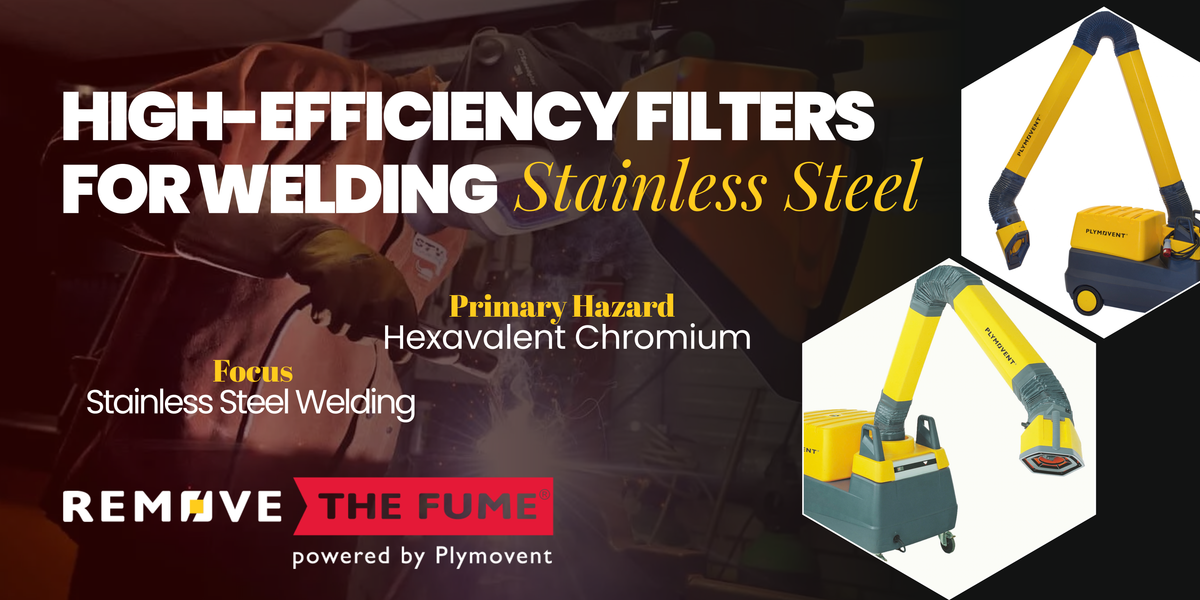
High-Efficiency Filters for Welding Stainless Steel
Welding stainless steel can generate fumes containing chromium, including hexavalent chromium, or Cr(VI). Because Cr(VI) is a serious occupational health hazard, stainless-steel welding requires careful exposure control, effective source capture and filtration suited to the application.
Why Does Stainless-Steel Welding Need Special Attention?
Stainless steel contains chromium to improve properties such as corrosion resistance. During welding and other hot work, some chromium can be converted into hexavalent chromium, also known as Cr(VI).
CCOHS notes that stainless-steel welding fumes can contain larger amounts of chromium, including hexavalent chromium, and nickel compared with mild-steel welding fumes.
The amount of Cr(VI) produced can vary according to the welding process, alloy, consumables, coatings, ventilation and other working conditions.
Sources: OSHA Hexavalent Chromium and CCOHS Welding Fumes and Gases
What Is Hexavalent Chromium?
Hexavalent chromium is chromium in the +6 oxidation state. It is commonly written as Cr(VI) or chromium 6.
Cr(VI) is not a welding gas. It can be present in the fine airborne particulate generated when chromium-containing metals are heated during welding and other hot-work processes.
OSHA identifies welding on stainless steel and other chromium-containing alloys as a major potential source of occupational exposure to Cr(VI).
What Is the OSHA Exposure Limit for Hexavalent Chromium?
Under OSHA's Chromium (VI) standard for general industry, the permissible exposure limit for airborne Cr(VI) is 5 micrograms per cubic meter of air as an 8-hour time-weighted average.
OSHA also defines an action level of 2.5 micrograms per cubic meter as an 8-hour time-weighted average.
Source: OSHA 29 CFR 1910.1026 Chromium (VI)
How Should Stainless-Steel Welding Fume Be Controlled?
The purpose of ventilation is to remove airborne contaminants from the welder's breathing zone and work area.
CCOHS identifies local exhaust ventilation as the preferred method for removing welding fumes and gases because it captures contaminants before they mix with the room air.
OSHA also requires engineering and work-practice controls to reduce Cr(VI) exposure where applicable. Respiratory protection may be required when feasible engineering controls cannot reduce exposure sufficiently.
- Assess the welding process, material and potential Cr(VI) exposure.
- Capture the welding plume close to the source.
- Keep the welder's breathing zone out of the plume.
- Select filtration suited to the contaminant and application.
- Maintain the extraction system and filters according to manufacturer requirements.
- Use additional respiratory protection where required by the exposure assessment and applicable regulations.
Why Is Extraction-Arm Position Important?
A flexible extraction arm allows the capture hood to be repositioned as the welding location changes.
CCOHS recommends placing a movable hood as close as practical to the welding work. The objective is to capture the fume plume before it passes through the welder's breathing zone or disperses through the shop.
Learn more from CCOHS Welding Ventilation .
Which Fume Extractors Can Be Used for Stainless-Steel Welding?
Remove The Fume offers several mobile and stationary extraction systems with high-efficiency filtration options. The correct configuration depends on welding volume, work location, available space and the exposure-control requirements of the application.
| Fume Extractor | Configuration | Typical Use |
|---|---|---|
| MFD | Disposable filter with High Efficiency option | Mobile extraction for medium-duty welding applications |
| MFS | Self-cleaning filter with High Efficiency option | Mobile extraction where automatic filter cleaning is preferred |
| MobilePro | Standard MERV 16 filter with optional H14 HEPA after-filter | Heavy-duty mobile welding and stainless-steel applications |
| SFD | Stationary disposable-filter system with High Efficiency option | Fixed welding stations where floor space is limited |
| SFS | Stationary self-cleaning system with High Efficiency option | Fixed medium- to heavy-duty welding stations |
Which Filter Should Be Used With the MFS?
For stainless-steel welding applications, Remove The Fume recommends selecting the High Efficiency filtration configuration for the MFS rather than the standard filter option.
The MFS is a mobile, self-cleaning fume extractor equipped with an UltraFlex extraction arm. Its RotaPulse system automatically cleans the filter cartridge and collects dust and debris in a dust tray.
The current MFS product configuration can be ordered with or without the High Efficiency filtration option.
Replacement high-efficiency filtration is available through the MFS/SFS High Efficiency Filter Pack .
Can the MFD Be Used for Stainless-Steel Welding?
Yes. The MFD is a mobile welding fume extractor with disposable filtration and is available with a High Efficiency option.
It uses an UltraFlex extraction arm to position the hood close to the welding plume and is designed for mobile use across multiple work areas.
A High Efficiency Filter Pack is available for MFD and SFD systems.
What About the MobilePro?
The MobilePro is designed for heavier-duty mobile welding applications and is recommended by Remove The Fume for stainless-steel welding.
Its current standard filter is a MERV 16 rated BiCo polyester filter with a PTFE membrane. An optional H14 HEPA after-filter is also available.
The system provides approximately 700 CFM of airflow at the hood and uses an integrated self-cleaning filter system.
For applications requiring the additional after-filter, see the MobilePro HEPA Filter Pack .
What If Floor Space Is Limited?
A stationary wall-mounted extractor can be useful when the welding location is fixed and floor space is limited.
Remove The Fume currently offers both the SFD disposable-filter system and the SFS self-cleaning system with High Efficiency configurations.
Both systems are wall mounted and use flexible extraction arms to capture welding fumes close to the source.
How Do Coatings Affect Welding Fume?
Welding-fume composition is affected not only by the base metal but also by surface coatings, plating, paints, residues and consumables.
CCOHS notes that coatings and residues can introduce additional hazardous substances into the welding fume, including chromates, zinc, cadmium, lead and decomposition products from paints and solvents.
Whenever possible, coatings should be identified before welding and removed safely where appropriate.
What Are the Health Effects of Hexavalent Chromium?
OSHA identifies Cr(VI) as a known human carcinogen. Occupational exposure can also affect the respiratory system, kidneys, liver, skin and eyes.
Welding stainless steel is one potential source of exposure, but workers may also encounter Cr(VI) during cutting, grinding and other hot-work processes involving chromium-containing alloys.
Workers in fabrication, construction, transportation, shipbuilding, repair and other metalworking environments may potentially be exposed depending on the materials and processes used.
Frequently Asked Questions
Does welding stainless steel produce hexavalent chromium?
It can. Stainless steel contains chromium, and the high temperatures involved in welding can oxidize chromium into hexavalent chromium compounds that become part of the welding fume.
Is hexavalent chromium a gas?
No. Hexavalent chromium is a chemical form of chromium. During stainless-steel welding it can be present in fine airborne particulate within the welding fume.
What is the OSHA limit for hexavalent chromium?
OSHA's general-industry permissible exposure limit is 5 micrograms of Cr(VI) per cubic meter of air as an 8-hour time-weighted average. OSHA's action level is 2.5 micrograms per cubic meter as an 8-hour TWA.
What type of fume extractor should be used for stainless steel?
The correct extractor depends on welding volume, mobility, shop layout and exposure conditions. Remove The Fume offers mobile and stationary systems with High Efficiency filtration configurations, while the MobilePro includes a MERV 16 standard filter and can be ordered with an H14 HEPA after-filter.
Is a high-efficiency filter enough by itself?
No. Effective exposure control depends on the complete system, including adequate airflow, correct hood placement, source capture, filter selection, maintenance and work practices. Respiratory protection may also be required depending on measured exposure and applicable regulations.
Where should the extraction arm be positioned?
The hood should be placed as close as practical to the welding plume without interfering with the process. It should be positioned so contaminated air is drawn away from the welder's breathing zone.
Related Reading
Need the Right Extractor for Stainless-Steel Welding?
Tell us your welding process, material, daily welding hours and whether the work stays in one location or moves around the shop. We can help narrow down the right extraction and filtration configuration.
Find the Right System


